Games as Laboratories for a Society in Flux.
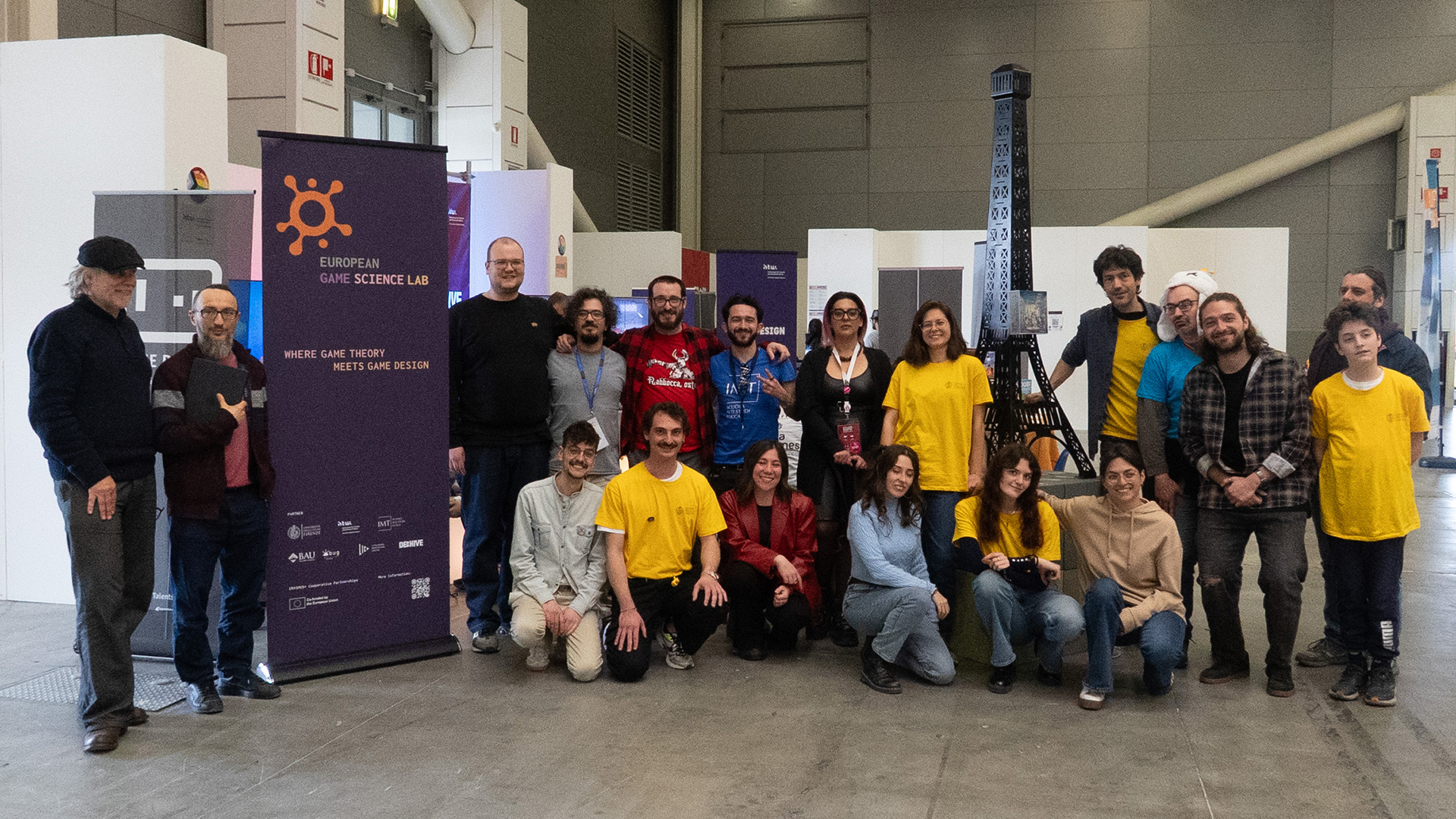
The European Game Science Lab (EGSL) unites game theory, systemic game design, and behavioral social sciences across five European partner institutions. We investigate how rule systems reflect and shape societal norms — and equip educators and students with rigorous frameworks to design inclusive, reflective, and transformative games.
“Games are powerful cultural artefacts and formal behavioral models at the same time — our mission is to unite quantitative game theory with creative game design pedagogy.”
Game Theory & Behavioral Economics
Anchored by the GAME Science Research Center at IMT School for Advanced Studies Lucca and the University of Florence, we examine strategic interaction, social dilemmas, cooperation incentives, and cognitive heuristics under uncertainty.
Systemic & Applied Game Design
Led by HTW Berlin (DE:HIVE) and Bahçeşehir University (BUG Game Lab), we translate formal rules into emergent mechanics, physical card systems, and rapid prototypes across tabletop, digital, and hybrid play formats.
Ludo-Narrative Literacy & Bias Detection
We develop structured methods for uncovering cultural and algorithmic biases in game rules and generative AI workflows — empowering students and non-game designers to build socially resonant systems.
Project Management & Quality Assurance
Consortium governance, transnational steering committees, budget controlling, risk management, and continuous evaluation of pedagogical impact across all five partner countries.
- Kick-off & Annual General Assemblies
- Quality Assurance & Evaluation Protocols
- Open-Access Compliance & GDPR Governance
Building the European Teaching Network
Establishing a sustainable alliance of game educators, researchers, and innovation hubs across Europe through public exhibitions, summer schools, and cross-faculty workshops.
- Annual EGSL Summer Schools ("Market of Ideas")
- Public Trials at PLAY Bologna & Lucca Comics
- Cross-Border Dissemination & Policy Transfer
Games in a Society in Flux
Investigating how societal transformation, representation, and algorithmic bias manifest in game systems — validated through international workshops and synchronous hybrid game jams.
- Two-Part Workshop Series: Biases in Game Rules
- Berlin–Istanbul Hybrid Game Jams (100+ Participants)
- 5-ECTS Modular Curriculum & Micro-Credentials
The LUNA Framework & AI Toolset
Iterative design, empirical playtesting, and publication of the Ludo-Narrative Game Design Framework (LUNA), including physical card decks, APCF ontology, and GenAI reflection tools.
- APCF Reference Axis & Ludeme Card Stacks
- Iterative Student & Studio Playtests (Daisy / Yarrow)
- Dedicated Platform: luna-framework.org
Get in Touch with the Consortium
We welcome inquiries from universities, game studies researchers, educators interested in testing the LUNA card decks, and institutions wishing to join the European Teaching Network.